

EQUITABLE ECONOMIC DEVELOPMENT

The Eli and Edythe Broad Foundation
Grantmaking Strategy Refinement
The Broad Foundation engaged Estolano Advisors to assist in refining its grantmaking strategy to guide the Foundation’s investments in the coming years. The refined strategy aims to increase access to economic opportunities in Los Angeles’ historically marginalized communities with a focus on a clean economy. To inform the direction of new grantmaking areas, our firm interviewed cross sector experts and practitioners, including community-based leaders, and gathered insights on crucial issues, opportunities, and unmet needs. Throughout the process, our team facilitated working sessions with foundation leadership to further define program priorities and goals. Estolano Advisors developed a grantmaking strategy that includes a problem statement, goals and objectives, and an articulation of key investment opportunities within each program area.

Local Initiatives Support Corporation, San Diego
Diamond District Inclusive Economic Resiliency Agenda
Our firm worked with LISC San Diego to develop an Economic Resiliency Agenda focused on San Diego’s Diamond District. The document is a three-year roadmap that supports an integrated, place-based approach to advancing economic mobility and resilience for communities in the Diamond District. The Agenda was informed by community-based organizations, local leaders, and local government to reflect recommendations that will nurture the District’s strengths, address areas of need, and foster climate resilience. The identified strategies relate to workforce development, small business development, place-making, and community ownership. Estolano Advisors conducted a quantitative baseline conditions analysis, an existing documents review, and interviews with various stakeholders. EA used feedback from LISC SD, a Community Advisory Group, and interviewed stakeholders to shape and refine the Agenda’s priorities and strategies.

County of Los Angeles
Economic Development Roadmap
Our firm developed an Economic Development Roadmap to guide implementation of an economic development fund that was established by the County of Los Angeles. The Roadmap recommends potential fund uses and enumerates tasks needed to carry out a robust economic development strategy.

City of Glendale
Tech Strategy
Estolano Advisors along with Mount Wilson Ventures and data analysts Madeline Wander and Pamela Stephens, developed a Tech Strategy for the City of Glendale by undertaking the following tasks: 1) defining the term “technology” and its subsectors, 2) understanding factors of success and assessing the economic landscape of Glendale, 3) determining promising tech subsectors for Glendale EDC to pursue, and 4) crafting strategies and initiatives that will create opportunities for business growth. As a part of this research, EA carried out interviews with local tech leaders and employers in the City of Glendale. The Tech Strategy was finalized in 2017. We then worked with the City to implement many recommendations set forth in the Strategy, EA assisted the City in the recruitment of applicants for the accelerator RFP, the evaluation of 20 proposals, and the selection of two operators – Hero House and Children’s Hospital KidsX.
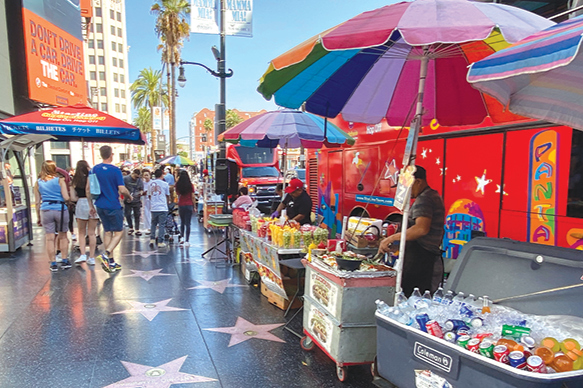
Los Angeles City Council District 13
Hollywood Blvd. Special Vending Zone Pilot
The Office of Los Angeles Councilmember Hugo Soto-Martinez Council District 13 (CD 13) engaged Estolano Advisors to develop recommendations for the Hollywood Special Vending Zone (SVZ) Pilot, a place-based initiative designed to create a fair, safe, and sustainable vending environment along the Hollywood Boulevard corridor. The SVZ Pilot aims to balance the needs of street vendors, brick-and-mortar businesses, and the broader community by improving coordination across agencies, expanding access to vendor resources, and enhancing the corridor’s economic and public space management. In partnership with Council District 13, we developed the Special Vending Zone Pilot recommendations through a multi-phase process. The phases comprised a landscape scan of local and national street vending practices, a Taskforce of business, vendor, and community representatives, listening sessions with residents, business representatives, and vendors, and technical advisory interviews with city and county agencies. Through this project, Estolano Advisors supported CD 13 find alignment and middle ground across a diverse range of stakeholders including city agencies, businesses, residents, and street vendors and street vendor advocates, and facilitated relationship building.

The New School
American Rescue Plan Act (ARPA) Briefs
As part of a larger Budget Equity Project exploring how equitably local governments used American Rescue Plan Act (ARPA) recovery funds, Estolano Advisors worked with the Institute on Race, Power, and Political Economy (IRPPE)to develop eight policy briefs that explore various ARPA uses. EA researched topics like Community Land Trusts, Guaranteed Income, Low-Cost Immigration Legal Assistance, Participatory Budgeting, and Workforce Wraparound Services to develop high-level overviews of each type of policy or program that include: the equity issue they address, the potential benefits, how to best design the policy or program, where it has been successful, complementary policies, and additional resources on the topic.

City of Los Angeles: Civil, Human Rights and Equity Department
Participatory Budgeting Pilot Evaluation
The Los Angeles Reforms for Equity and Public Acknowledgment of Institutional Racism (L.A. REPAIR) launched its first participatory budgeting program where it will distribute $8.5 million to nine highest need neighborhoods in the city of L.A called REPAIR Zones. Through a democratic process, residents will determine how this funding is used. The Participatory Budgeting Project (PBP) engaged EA on behalf of LA CHRED to evaluate to what extent this inaugural pilot deepens democracy, expands transparency, emphasizes public ownership of government resources, and builds stronger communities. EA partnered closely with PBP and LA CHRED to conduct a mixed methods evaluation of the program pilot’s two cohorts across four programmatic outcomes approved by the City of Los Angeles City Council. For the evaluation, EA developed evaluation metrics for each stage of the participatory budgeting process, adapting for key stakeholder audiences; created and administered qualitative surveys; and analyzed both qualitative survey results and quantitative demographic participant data against neighborhood-specific Census data. EA also designed an event observation protocol and trained program staff, members of the program’s Advisory Committee and Community Engagement Partners.

LA Metro
Business Interruption Fund
Estolano Advisors contributed to an assessment of LA Metro’s Business Interruption Fund (BIF), which provides grants to eligible small businesses demonstrating revenue loss during transit construction. Using data from Metro, Lightcast, and the LA County Assessor, EA developed parcel-based maps of small businesses potentially eligible for BIF support along the planned East San Fernando Valley Light Rail Transit, Southeast Gateway Light Rail Transit, North Hollywood to Pasadena Bus Rapid Transit, and G Line Bus Rapid Transit Improvement projects. To provide additional context on these parcel maps, We conducted observational surveys along each corridor to understand potential limitations and nuances in the Lightcast data. We also developed corridor maps for other planned rail and bus rapid transit projects to estimate the number of businesses potentially eligible for the BIF.
County of Los Angeles
Economic Development Roadmap
Our firm developed an Economic Development Roadmap to guide implementation of an economic development fund that was established by the County of Los Angeles. The Roadmap recommends potential fund uses and enumerates tasks needed to carry out a robust economic development strategy.
City of Glendale
Tech Strategy
Estolano Advisors along with Mount Wilson Ventures and data analysts Madeline Wander and Pamela Stephens, developed a Tech Strategy for the City of Glendale by undertaking the following tasks: 1) defining the term “technology” and its subsectors, 2) understanding factors of success and assessing the economic landscape of Glendale, 3) determining promising tech subsectors for Glendale EDC to pursue, and 4) crafting strategies and initiatives that will create opportunities for business growth. As a part of this research, EA carried out interviews with local tech leaders and employers in the City of Glendale. The Tech Strategy was finalized in 2017. We then worked with the City to implement many recommendations set forth in the Strategy, EA assisted the City in the recruitment of applicants for the accelerator RFP, the evaluation of 20 proposals, and the selection of two operators – Hero House and Children’s Hospital KidsX.
Los Angeles City Council District 13
Hollywood Blvd. Special Vending Zone Pilot
The Office of Los Angeles Councilmember Hugo Soto-Martinez Council District 13 (CD 13) engaged Estolano Advisors to develop recommendations for the Hollywood Special Vending Zone (SVZ) Pilot, a place-based initiative designed to create a fair, safe, and sustainable vending environment along the Hollywood Boulevard corridor. The SVZ Pilot aims to balance the needs of street vendors, brick-and-mortar businesses, and the broader community by improving coordination across agencies, expanding access to vendor resources, and enhancing the corridor’s economic and public space management. In partnership with Council District 13, we developed the Special Vending Zone Pilot recommendations through a multi-phase process. The phases comprised a landscape scan of local and national street vending practices, a Taskforce of business, vendor, and community representatives, listening sessions with residents, business representatives, and vendors, and technical advisory interviews with city and county agencies. Through this project, Estolano Advisors supported CD 13 find alignment and middle ground across a diverse range of stakeholders including city agencies, businesses, residents, and street vendors and street vendor advocates, and facilitated relationship building.
The New School
American Rescue Plan Act (ARPA) Briefs
As part of a larger Budget Equity Project exploring how equitably local governments used American Rescue Plan Act (ARPA) recovery funds, Estolano Advisors worked with the Institute on Race, Power, and Political Economy (IRPPE)to develop eight policy briefs that explore various ARPA uses. EA researched topics like Community Land Trusts, Guaranteed Income, Low-Cost Immigration Legal Assistance, Participatory Budgeting, and Workforce Wraparound Services to develop high-level overviews of each type of policy or program that include: the equity issue they address, the potential benefits, how to best design the policy or program, where it has been successful, complementary policies, and additional resources on the topic.
City of Los Angeles: Civil, Human Rights and Equity Department
Participatory Budgeting Pilot Evaluation
The Los Angeles Reforms for Equity and Public Acknowledgment of Institutional Racism (L.A. REPAIR) launched its first participatory budgeting program where it will distribute $8.5 million to nine highest need neighborhoods in the city of L.A called REPAIR Zones. Through a democratic process, residents will determine how this funding is used. The Participatory Budgeting Project (PBP) engaged EA on behalf of LA CHRED to evaluate to what extent this inaugural pilot deepens democracy, expands transparency, emphasizes public ownership of government resources, and builds stronger communities. EA partnered closely with PBP and LA CHRED to conduct a mixed methods evaluation of the program pilot’s two cohorts across four programmatic outcomes approved by the City of Los Angeles City Council. For the evaluation, EA developed evaluation metrics for each stage of the participatory budgeting process, adapting for key stakeholder audiences; created and administered qualitative surveys; and analyzed both qualitative survey results and quantitative demographic participant data against neighborhood-specific Census data. EA also designed an event observation protocol and trained program staff, members of the program’s Advisory Committee and Community Engagement Partners.